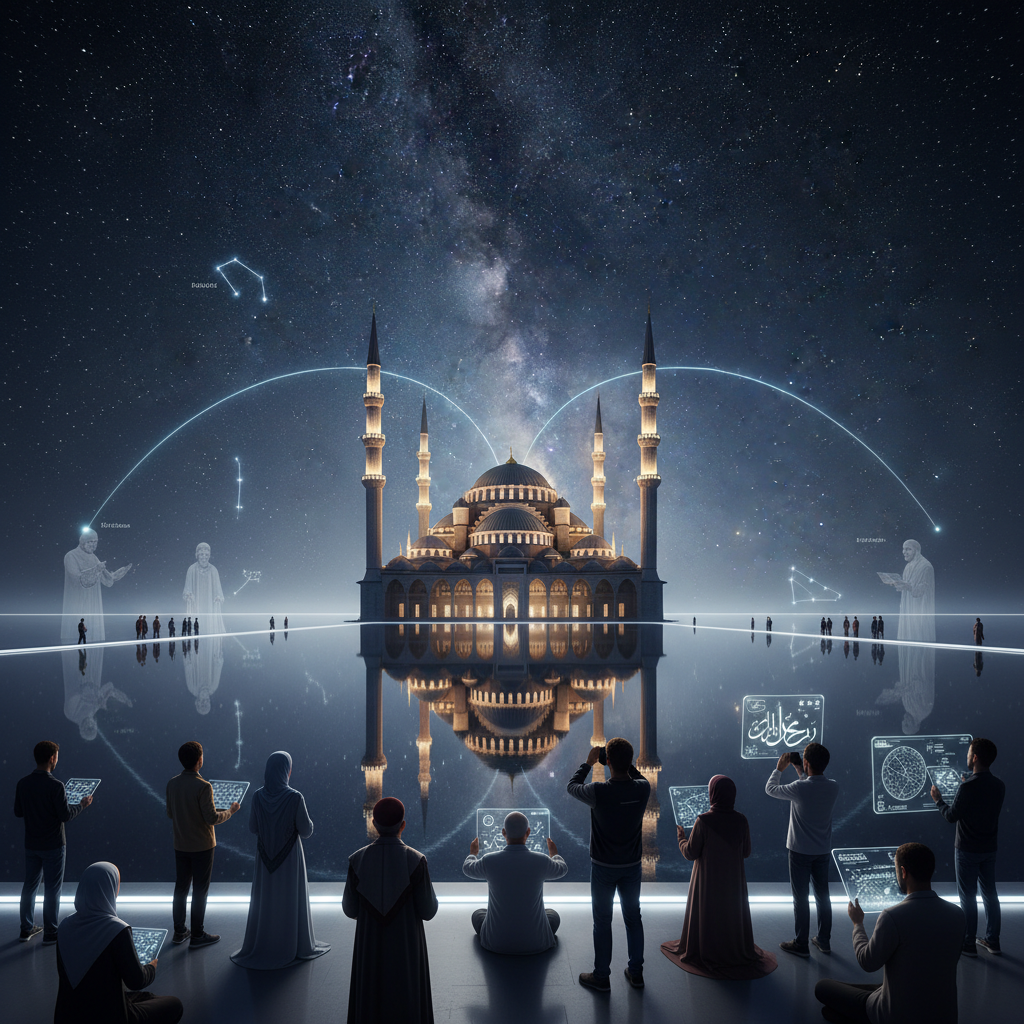
Eyüp Sultan Mosque's Celestial Mirror in 2026: Tracing Astronomy and Ancient Wisdom
The Eyüp Sultan Mosque, a spiritual cornerstone of Istanbul, continues to captivate in 2026, not just for its stunning architecture and rich history, but also its profound ties to astronomy and ancient wisdom. From Ottoman-era celestial observations to its architectural alignments, delve into how this sacred site mirrors the cosmos. Discover the blend of faith, science, and heritage embedded within its walls.
Eyüp Sultan Mosque Astronomy: Unveiling Celestial Connections in 2026
The Eyüp Sultan Mosque, a spiritual cornerstone of Istanbul, has long captivated scholars due to its profound connections with astronomy. As we journey through 2026, the unique architectural and historical significance of this mosque extends beyond its earthly presence, revealing a deep relationship with the cosmos. This exploration delves into Eyüp Sultan Mosque Astronomy, showcasing how religious and scientific centers historically functioned as observatories, guiding humanity's understanding of the universe. Consequently, the lands surrounding the Eyüp Sultan Mosque and its neighborhood have always been a special nexus where science and faith intertwined, particularly in the realm of Eyüp Sultan Mosque Astronomy.
Astronomy's Influence on Eyüp Sultan Mosque's Construction
The construction of the Eyüp Sultan Mosque was meticulously planned, guided not only by architectural brilliance but also by the advanced astronomical knowledge of its era. Crucially, precise celestial calculations were indispensable for determining the accurate direction of the Qibla, a fundamental aspect of Islamic prayer. This demonstrates the early integration of Eyüp Sultan Mosque Astronomy into its very foundations.
Qibla Determination and Astronomical Precision
- Qibla Direction: Firstly, determining the Qibla's exact direction is paramount for any mosque. This precision was achieved through sophisticated astronomical measurements, leveraging the positions of the sun and stars with instruments like astrolabes, a key aspect of Eyüp Sultan Mosque Astronomy.
- Architectural Orientation: Additionally, architects diligently applied this astronomical data to the mosque's overall layout, particularly in the placement of the mihrab. Any error in Qibla determination was deemed unacceptable, reflecting both religious conviction and scientific understanding of the time.
- Mathematics and Geometry: Moreover, astronomy is inherently linked to mathematics and geometry. The intricate geometric patterns and proportions integral to the mosque's design likely drew inspiration from these astronomical principles in Islamic art, further enriching the field of Eyüp Sultan Mosque Astronomy.
Thus, the Eyüp Sultan Mosque stands as a testament not only to faith but also to the exceptional scientific and technical prowess of its time. The integration of Eyüp Sultan Mosque Astronomy ensures its enduring spiritual and structural integrity.
Ottoman Era Science and Eyüp Sultan Mosque Astronomy
The Ottoman Empire, building upon the rich scientific legacy of Islamic civilization, achieved remarkable advancements, especially in the field of astronomy. Mosques, madrasas, and observatories played pivotal roles in these scientific endeavors. The Eyüp Sultan Mosque and its environs were integral to this era of vibrant scientific exploration, showcasing significant contributions to Eyüp Sultan Mosque Astronomy.
The Müneccimbaşı Tradition and Observational Practices
- Institution of Müneccimbaşı: Within the Ottoman court, the "Müneccimbaşı" (Chief Astrologer) held a significant position, overseeing astronomical sciences. These experts were responsible for timekeeping, calendar preparation, new moon sightings, and even strategic military predictions, all contributing to Eyüp Sultan Mosque Astronomy.
- Observation Activities: Furthermore, major mosques occasionally served as temporary observation points. Celestial bodies were meticulously tracked, primarily to determine accurate prayer times and the sighting of the new moon.
- Astronomy Education: Importantly, madrasas surrounding the Eyüp Sultan Mosque provided education in rational sciences such as mathematics, philosophy, and astronomy, alongside religious studies. This fostered the widespread development of astronomical knowledge, enriching the understanding of statesmen shaped by these influences, and the broader concept of Eyüp Sultan Mosque Astronomy.
Ultimately, the Eyüp Sultan Mosque embodies a profound historical context, representing both a place of worship and a hub for scientific thought and astronomical studies. In 2026, rediscovering and highlighting the mosque's scientific heritage in light of this rich past remains critically important for understanding Eyüp Sultan Mosque Astronomy.
Subtle Astronomical Symbols in Eyüp Sultan Mosque's Architecture
A closer examination of the Eyüp Sultan Mosque's architecture reveals not just structural brilliance but also layers of hidden meaning and symbolism. The principles of astronomy and the cosmic order often found unique expression within the mosque's intricate design, a testament to Eyüp Sultan Mosque Astronomy.
Geometric Patterns and Cosmic Harmony
- Domes and the Sky: Firstly, the mosque's main dome frequently symbolizes the "sky" or the "vault of the universe." Its interior decorations often feature stars, planets, or geometric shapes, all reflecting cosmic order and the influence of Eyüp Sultan Mosque Astronomy.
- Tiles and Star Motifs: Moreover, the mosque's vibrant tiles commonly display star and octagonal motifs. In Islamic art, these motifs majestically represent the universe's order, the passage of time, and eternity. The symmetrical arrangement within these patterns directly correlates with the regular movements of celestial bodies.
- Mihrab Alignment: Finally, the precise orientation of the mihrab towards the Qibla is not merely a practical requirement. It also powerfully signifies the profound importance placed on divine order and cosmic harmony, further emphasizing the role of Eyüp Sultan Mosque Astronomy. Delve deeper into the masterpieces of calligraphy and illumination which also often incorporate such motifs.
These architectural details resonate within the Eyüp Sultan Mosque, serving as a material reflection of humanity's ancient quest to comprehend both the transient moment and the vast universe. This enduring structure stands as concrete evidence of the astronomical knowledge and cosmic understanding prevalent in its time. In 2026, contemporary interpretations of these symbols can significantly enhance the mosque's cultural and scientific value, particularly in the context of Eyüp Sultan Mosque Astronomy.
Rediscovering Eyüp Sultan Mosque's Astronomical Heritage in 2026
In 2026, amidst rapid scientific and technological advancements, new avenues emerge for rediscovering and illuminating the rich astronomical heritage of the Eyüp Sultan Mosque. Engaging with this heritage not only deepens our cultural awareness but also forges a vital link between the past and the future, especially regarding Eyüp Sultan Mosque Astronomy.
Modern Technologies for Historical Analysis
- Digital Reconstructions: Firstly, digital reconstructions of the mosque and its historical observation points can provide invaluable insights into ancient astronomical practices, enhancing our understanding of Eyüp Sultan Mosque Astronomy.
- Augmented Reality: Secondly, immersive augmented reality applications can be developed for visitors, both inside and outside the mosque, animating past astronomical events or observational work related to Eyüp Sultan Mosque Astronomy.
- Educational Programs: Lastly, compelling documentaries and educational programs explaining the astronomical dimension of the Eyüp Sultan Mosque can effectively reach broad audiences. For modern perspectives on Islamic astronomy, consider resources like those from the Foundation for Science, Technology and Civilisation.
These innovative approaches will transform the perception of the Eyüp Sultan Mosque, positioning it not solely as a place of worship but as a significant cultural and scientific heritage site, much like uncovering the mosque's underground secrets and forgotten vaults brings new understanding. Specifically, transmitting the connection between the Eyüp Sultan Mosque and astronomy to younger generations will reinforce the timeless idea that science and faith can harmoniously coexist. Indeed, 2026 presents an opportune moment to fuse this ancient knowledge with contemporary possibilities, thus unlocking new horizons for Eyüp Sultan Mosque Astronomy.
The Cosmic Vista and Spiritual Depth of Eyüp Sultan Mosque
Stepping into the tranquil atmosphere of this historic site, away from Istanbul's bustling crowds, one experiences the Eyüp Sultan Mosque not merely as a physical structure, but as a gateway to a cosmic vista. This profound spiritual depth is further amplified by its intrinsic connection to astronomy, particularly Eyüp Sultan Mosque Astronomy.
Astronomy and Faith Across Time
- Gazing at the Stars: In past centuries, unobstructed views of the night sky from the mosque's courtyard or nearby hills were common, unlike today's light-polluted skies. These observations profoundly deepened contemplation about the universe and the Creator, a core element of Eyüp Sultan Mosque Astronomy.
- Time and Worship: Furthermore, one of the most fundamental practical applications of astronomical knowledge specific to the Eyüp Sultan Mosque concerned the precise determination of prayer times. The sun's movements and the moon's phases intricately shaped the rhythm of both worship and daily life.
- Spiritual Journey: Finally, prayers and supplications made in the revered presence of Eyüp Sultan Hazretleri, interwoven with the infinite expanse of the starry sky, seamlessly integrate into a unique cosmic spiritual journey. This underscores the rich tapestry of Eyüp Sultan Mosque Astronomy. For further reading on the intersection of spirituality and science in Islam, the Encyclopædia Britannica on Islamic Science offers valuable perspectives.
As we navigate 2026, it is profoundly important to acknowledge and celebrate this silent yet powerful dialogue between this iconic mosque and the heavens, and to share this profound connection with a wider audience. The Eyüp Sultan Mosque continues to shine brightly as a beacon, not just on Earth but also in the celestial realm, illuminated by ancient knowledge. This enduring heritage persistently inspires visitors and flawlessly carries the wisdom of the past into the present day, especially through the lens of Eyüp Sultan Mosque Astronomy.
Sıkça Sorulan Sorular
What is the significance of astronomy in the construction of Eyüp Sultan Mosque?
Astronomy played a crucial role in the meticulous planning and construction of the Eyüp Sultan Mosque. Precise celestial calculations were essential for accurately determining the Qibla direction, which is fundamental for Islamic prayer. This involved using instruments like astrolabes to leverage the positions of the sun and stars, ensuring the mosque's architectural orientation, especially the mihrab, was perfectly aligned.
How was the Qibla direction determined for the Eyüp Sultan Mosque?
The Qibla direction for the Eyüp Sultan Mosque was determined with remarkable precision through sophisticated astronomical measurements. Builders and scholars used the exact positions of celestial bodies like the sun and stars, often employing instruments such as astrolabes. This ensured the mosque's layout and the mihrab's placement were accurately oriented towards the Kaaba, reflecting both religious devotion and advanced scientific understanding of the era.
Did the geometric patterns of Eyüp Sultan Mosque have astronomical connections?
Yes, the intricate geometric patterns and proportions integral to the Eyüp Sultan Mosque's design likely drew inspiration from astronomical principles. Given the close link between astronomy, mathematics, and geometry in that period, it's highly probable that the architectural aesthetics and structural integrity were informed by these scientific methodologies, showcasing a harmonious blend of faith and scientific knowledge.